Robots is Released
A few days ago, I released my lastest video, " Robots". It’s a fan-tribute music video based on the song of the same name by Flight of the Conchords. Check it out and enjoy.
Revisiting the Experiment
Almost a year ago, I mentioned that I had discovered the site www.mytoons.com. In that blog post I mentioned that I felt my animation wasn’t really getting the amount of views I hoped they would get. So I put my animation on mytoons and when the results weren’t immediately different, I completely forgot about my experiment. I check back on MyToons.com from time to time because of their great newsletter, Animation Snack. But I hardly ever check on my own videos. Well, I did a check today and the results are astonishing!
Blender 2.46 Released! (Yesterday)
Blender 2.46 was released yesterday and it has a whole bunch of new features- mostly created to facilitate production of Big Buck Bunny. What I’m looking forward to the most is hair/fur rendering, any tools that make armatures easier to skin (the bane of my animation hobby!), a cloth simulator, and the improved sequencer which should allow most of the video editing to take place inside of Blender.
I’d love to play with it, but right now I’m working on some animation projects so I need to wait until at least Fedora comes out with the 2.46 rpm. Ideally also my FreeBSD render farm would also get updated. A lot of the new goodies like hair/fur rendering are not backwards compatible. Good job from the coding team and I hope to test it out soon enough.
FarmerJoe - An easier render solution.
I’ve been very happy until now with drqueue. Developed by Jorge Daza, it’s a very nice render farm management software with a nice GUI. It worked relatively well for me for “Jose’s Dinner” and " Schrodinger’s Cat". However, there were two big kinks in using drqueue. First of all, Windows support was so sketchy it might as well be non-existent. So my most powerful computer was left out of the render-pool. Second, with the latest iteration, it no longer works on BSD computers. I tried for a few nights to make it work, but to no avail. So I turned to FarmerJoe.
MakeHuman makes huge strides
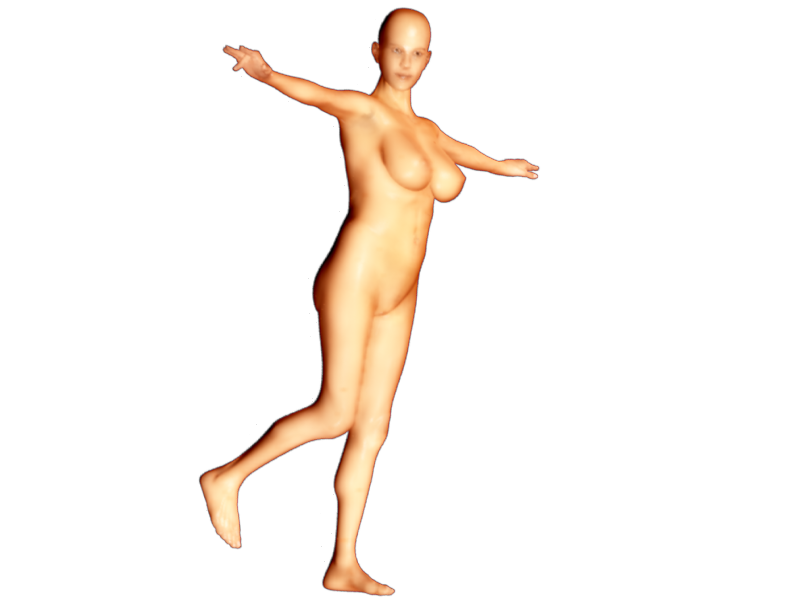 You’re probably asking yourself two questions. 1) When did Eric get awesome at modeling humans? and 2) What are these bald, naked women doing on this site? In fact, you probably asked yourself those questions in the reverse order. Extra points for the MakeHuman team if you didn’t even realize those were computer images and thought they were real.
 So, to start off with question 1, I didn’t model those humans in the traditional sense. In other words, I didn’t start with a box or plane and build up a human from there. Instead I used a program called MakeHuman which has similar goals to the commercial software Poser. Poser, as those of us into 3D art and animation know, is software for the posing, animating, and rendering of humans (and occasionally other creatures). Both software packages exist because animators may not want to also be character modelers. Instead they may wish to use a package such as MakeHuman which creates the character meshes and materials for them and then work on the animation. In such a context I wouldn’t call it cheating. After all, in a studio, most artists specialize on one part of the animation (eg animation, modeling, texturing, etc). I may even see myself using MakeHuman or Poser if I wished to have a realistic human character in my animation.
Upgrading to the latest Dr Queue Render Manager
Since I don’t have any animation needing to be rendered for a few months, I decided it was a great time to upgrade Dr Queue to the latest version. I’d heard that a lot of improvements had been added since version 0.60. So let’s see how the upgrade process goes:
On Mario, my Fedora 8 machine, I had to install scons first as it’s now used to buld dr queue. I also had to build it on my FreeBSD machines, starting with KingKoopa, the render master. This also required python to be installed. For Mario, it was very easy, I just ran the install script and it wrote over the old stuff and appears to work. I’ll probably need to copy the new directories over to the common hard drive. Peach and BulletBill already had python installed so they didn’t need scons installed.
Another Shot at Indigo and Suzanne
Posted over on Blender artist s and told them about the problems I was having with Indigo and getting it to render Suzanne as glass. It turned out that I had two things wrong. One: I needed to set the gain to 2 instead of the standard 100. Apparently this controls the transparency level. Two: I needed to set the absorption color as it didn’t transfer over from Blender. In fact, a quick look on the Indigo forums showed that the materials don’t export over well without some work. Here’s the final result after 28 hours:
First Try with Indigo Renderer
For nearly a year now, I’ve seen a lot of really great images in the blender gallery. Many of the most breathtaking images are rendered with outside renderers like Yafray or Indigo. Here’s an example of a subtle, but real-looking render made with Indigo.
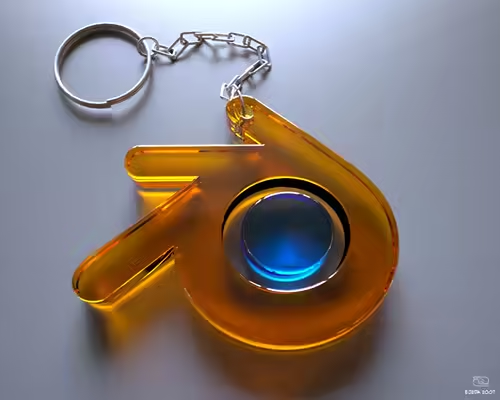
I already tried Yafray before, and didn’t really like it too much. I decided to give Indigo a shot. So I went to the Indigo website and followed their directions for rendering with Indigo from Blender. The tutorial shows it as coming out like this:
Night of the Living Dead Pixels
Check out this great short film made in Blender. It’s a must see!! I can’t say more without ruining the plot.