Dice Advent Calendar 2025 Day 03
Day 03
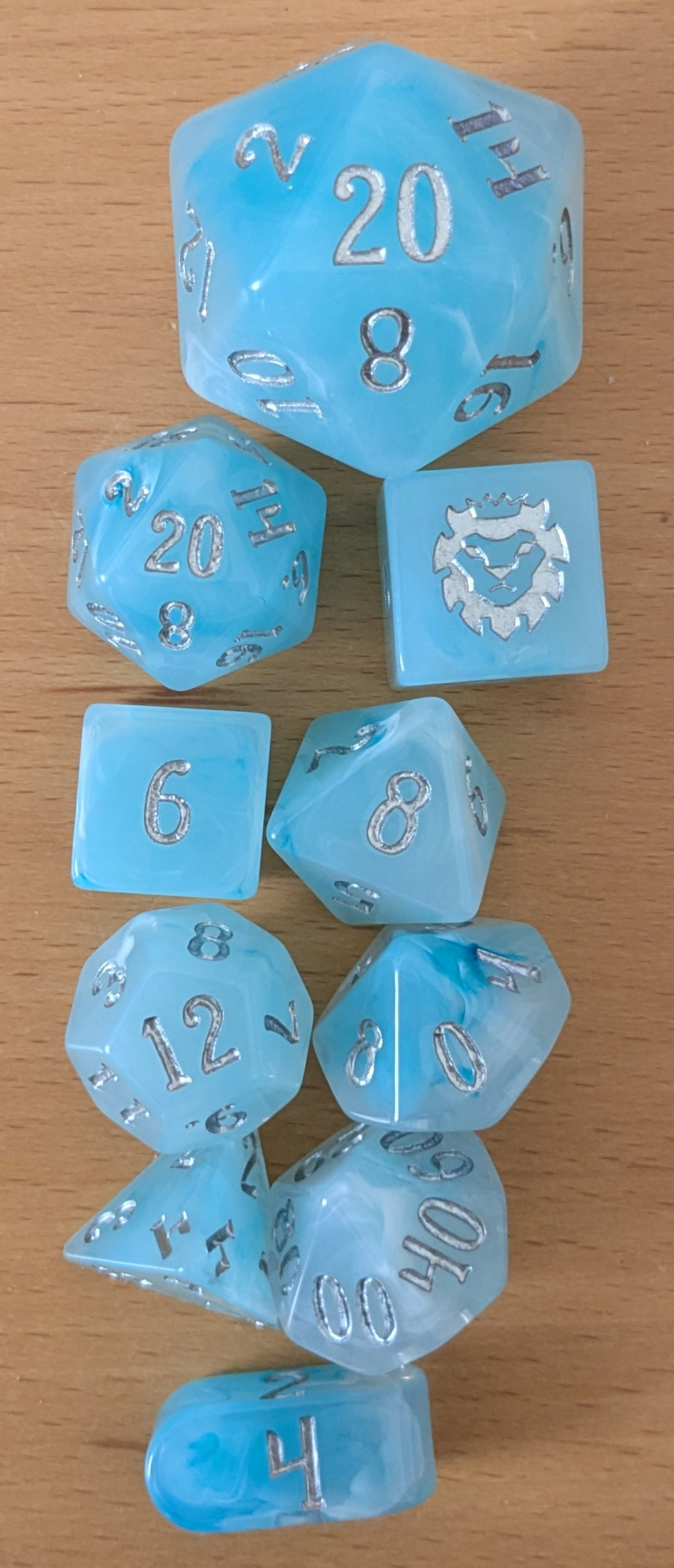
What’s always fun about the early days in the Dice Envy Advent Calendar is that I don’t yet know which dice are part of sets and which dice are standalone dice. Looking back at last year’s calendar there was one Dice Envy Special (meaning chonky d20, chonky d6, and infinity d4), one 8-piece set, 6 random dice (including 3 d12s - so it turns out to be easy to do a Daggerhart hope/fear with those), and a Wee Lads set. So as I opened up today’s flap, I was curious to see what I would get.
Dice Advent Calendar 2025 Day 02
Day 02
Krampus seems to be tied to a purple theme. I’m not sure I’d consider purple to be the opposite of red, but who knows? Maybe it’s an inversion of purple being a royal color? As far as I can remember, this isn’t just a Dice Envy thing - I’ve seen Krampus associated with purple elsewhere. All this to say, I expected purple dice and I was not disappointed.
Dice Advent Calendar 2025 Day 01
I wasn’t sure I was going to get Dice Envy’s 2025 Dice Advent Calendar. I had a blast opening each day last year, but, as you can see, I don’t really need any more dice:

All my dice as of the beginning of Dec 2025
But then Dice Envy went and got creative by releasing both a Krampus and a Santa box. I was very curious what interpretation Dice Envy might have a for an “evil” Christmas dice advent calendar. After all, last year had lots of Christmas-y dice like the ones I called Elsa Blue or the 12 days of Christmas d12. Enough preamble, let’s go!
Campaign Length: A Different Kind of Mercer Effect
For people who are new to TTRPGs (especially d20 games like D&D, Pathfinder, or Tales of the Valiant), it’s hard to know how long a story, or campaign, should be. Newbies only have two examples: Actual Plays on YouTube and Twitch or the campaign books published by Wizards of the Coast, Paizo, and Kobold Press. Campaigns published for 5e tend to be (in my experience) 8-12 adventures long. The time required for any given tale to finish a campaign depends on how long each session is. (At the fastest - one session per adventure you’re looking at about a year to finish the campaign) Alternatively, looking to Critical Role as an example finds the gang playing campaigns (Vox Machina, Mighty Nein, Bells Hells) that are years long each. This is why I subtitled the post “A Different Kind of Mercer Effect” (in reference to the original Mercer effect - where inexperienced GMs try to mimic his voices, accents, and GM style) I do know that there are other campaigns that go for a long time - including the GRRM campaign that led to Wild Cards, but most new TTRPG players and GMs will have more of a chance of having come to the game after having seen Critical Role vs those other examples.
A Followup on D&D Editions
A month ago I posted about how TTRPG editions don’t truly die. Then I went down a Matt Coleville rabbit hole and discovered this video. I think it adds a lot of historical context to what I was writing about as a TTRPG newbie.
Matt brings a lot to the table: his great conversational style, his history with the game, his reasonable opinions. I think the fact that he’s seen this happen a few times before gives the best perspective on what it means for new D&D editions to arise.
Post Updates
It’s been an unusually productive few weeks for me when it comes to blog posts and there have been some updates and social media responses, so I wanted to talk about some of those here. (this isn’t to say that I will always create a post encompassing social media replies, I think they are just especially relevant)
On the 17th I wrote a blog post comparing Game Master / Dungeon Master books across TTRPGs. There were 2 replies worth pointing out. First of all, there was a post by Shades Corvid which confirmed my assertion that Pathfinder did have the Player Core and GM Core as one book in the past, but player demand wanted them as 2 books since the combined book was so huge. Kobold Press also wanted to point out that they consider the GMG to be an optional book. We could probably quibble over the tiniest details on that point, but they aren’t entirely wrong. I would argue that Wizards of the Cost could probably say the same about their DMG. It’s really only Paizo with the history of Golarian in the GM Core that would seem to be slightly less optional for anyone who wanted to play in Golarian.
TTRPG Editions Don't Die
Continuing my recent spate of posts documenting my evolving thoughts on TTRPGs as I learn more about the hobby, I wanted to share my thoughts on people playing older releases of TTRPGs. As I’ve mentioned this week (and previously) I started off with D&D 5e 2014. For the beginning of my time in fandom all I ever heard was that a lot of the greybeards thought that D&D 3.5e was the last good edition and either kept playing that or moved on to Pathfinder 1e (which was based on it and has been nicknamed D&D 3.75). Tainted by thinking about this in the same way as software, I thought this was like people who were still using Windows 95 or MS Office 2003 because they refused to learn the latest interface and hated dealing with change.
Comparing Game Master / Dungeon Master books across TTRPGs
The classic TTRPGs like Pathfinder and D&D (along with 5e fork Tales of the Valiant) have at least 3 main sourcebooks. (See my previous post about expanding those options) Many newer systems like Daggerheart or Cosmere have only one book that contains both player and game master sections. On the one hand, it’s nice to just have to buy one book and have everything all together - there’s often a lot of overlap in what content is for the player and what is for the GM. That said, in a previous iteration, Pathfinder had all the information in one book and people complained that the book was too massive.
FoundryVTT Support for D&D, Tales of the Valiant, and Pathfinder
I love using FoundryVTT to play TTRPGs online and I have played many game systems. Which one has the best support in FoundryVTT? Click through to watch the video and find out.
How the Hobby Handles Expanding the TTRPG Player Options
As someone who is relatively new to TTRPGs (~3 years at this point, give or take), I first started with D&D 5e 2014. Before I could buy too many adventures or campaigns, D&D 5e 2024 came out. So, in my mind, a TTRPG should have 3 core books containing all the species (formerly races), classes, subclasses, monsters, and so on needed to play. Then, in 2024 I heard about the 5e fork Tales of the Valiant. If you’ve spent any time on my blog recently, you know that we’ve gone all-in on Tales of the Valiant, and haven’t really played D&D since. But I thought it was weird that Kobold Press started doing kickstarters for Monster Vault 2 and Player’s Guide 2 and were adding new species/ancestries in The Labyrinth Worldbook. “Well,” I told myself, “D&D has been around for 50 years. It’s had time to establish itself. Maybe KP needs to just put these books out now?”