The Initial Failure and Eventual Triumph of Social Media in my Attempts to Get Tech Support to Help
A little past the end of February I started having problems with my internet connected devices. In the basement we have a Roku box that the wife uses to watch Netflix. She reported that it was no longer connecting to Netflix. We’d had issues before with it needing to be re-registered with Netflix, but that did not seem to be the case. I’d click on the Netflix channel and it would say “retrieving movies” for a while and then pop back to the main menu. At first I thought something was wrong with the Roku box, so I tried the Amazon channel, but that worked and I was able to watch my content. I figured it’d resolve itself. So she just popped in the latest DVD from Netflix into our DVD player. Later that night she was in the bedroom and learned that our Samsung BluRay player was no longer connecting to Netflix. I thought that was weird, but figured maybe it was a Netflix problem. I checked on my computer and I couldn’t log into the Netflix site. Neither could Danielle on her computer. These were Linux boxes (Fedora and Ubuntu respectively) so I tried on my Windows computer. Strangely, that one could log in. That’s weird. I tried on both Firefox and Chrome with no difference. So then I tried the guest computer - that computer hadn’t been used since December and I knew it was working for Netflix back then. That would help me eliminate the possibility that I’d installed a distro update that had killed it for me. (I knew that didn’t totally make sense because of the BluRay Player and Roku) That one could reach it either. What was going on here? Was Netflix blocking Linux? Well, I figured it might go away so I waited until the next day.
Automatically Posting your Top 3 Artists from Last.fm onto Twitter (with Python!)
I wrote this code a while back because a website that does the same thing seemed to miss my posts every other week. So I figured I’d write my own in python to do the same thing to me. Then I just put it into a cron job to automatically run it every Sunday. I’m going to be posting the code on my GPL code page. Here it is for you to see and for Google to index. Just fill in the appropriate variables with the secret keys you get from each site’s API.
Boxee: Further Impressions
After writing my Boxee review based on my experience over the weekend, I tried to use it again Tuesday and Wednesday. There two shows that I watch Tues-Friday: The Daily Show and The Colbert Report. I’m not sure what API or screen scraping Boxee uses for these sites, but it needs to be improved. When I went to look for Monday’s episode on Tuesday, it wasn’t there. And Colbert didn’t appear to have any shows since mid-November. That tipped me off to check their websites and see that they did, indeed, have new episodes. Very disappointing. I don’t want to pay $200 for a device that works worse than a web browser on the shows that are important to me.
Getting my new Sandisk Sansa Fuze to work with gPodder
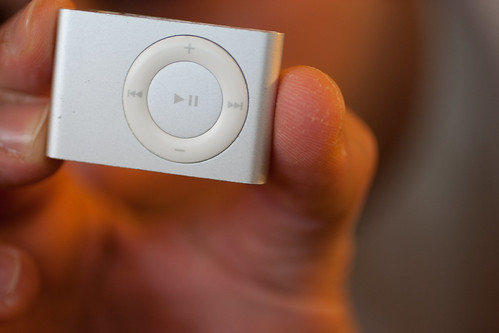
So, a while back I caved and got an iPod shuffle. While it worked well at first, over the last year it has been a constant pain in my butt. All I want to do is use gPodder to get my podcasts and listen to them on the way to work and at the gym. I went with the iPod shuffle because it was sub $100 and I didn’t really need to spend the money for the screen in the Nano. Not having a screen meant just listening in order and having to check gtkPod to make sure I’d listened to all the podcasts before clearing the iPod. Let me get into my workflow and why the shuffle became a real pain.
Customizing the Look of the OS
I forgot what post online got me thinking about this stuff, but I really don’t customize my computers’ desktop environments much. Generally, I tend to change the background image and leave it at that. I took a look over my desktop image gallery here on the blog to confirm my suspicions.
Starting at the bottom with Windows, you can see that until 2009 I was just going with the default look. I tended not to add launchers to my panel because, with Windows XP, it ended up really limiting the space for listen the open programs. I also didn’t have too many launchers on the desktop. I tend to always have programs maximised if I’m in front of the computer, so the only programs shortcuts I’d leave on the desktop are programs I’d be likely to launch upon starting up the computer. In fact, whenever I pay attention, I tell the installer not to put icons on the desktop.
Interesting CPU Behavior

I never really knew much about how CPUs worked until I took a class in CPU design at Cornell. Until that point I never knew about registers and cache and pipelines. Ever since then I’ve been growing in my understanding of how the CPU works and how all the parts fit together. This culminated in me building five or six computers for myself and relatives. In that past few years, these computers have been dual or quad core computers. I’ve been using a dual core computer for my Linux computer for around a year now but I didn’t really think about it too much until this weekend. I was working on a new strip for my webcomic, " I’m Not Mad" (which I do with Nothing to the Table’s Daniel). A particular panel was taking forever to render, so I opened up the system monitor to take a look. The image was split into a bunch of squares and each square was given to a CPU core to work on. And, for basically the entire render time, both CPUs were maxed out as I expected. When it only had one square to do, one of the CPUs dropped to idle because there wasn’t anything for it to do. Nothing out of the ordinary there. But then I noticed this crazy pattern:
The Next HOPE: A Defcon Prequel
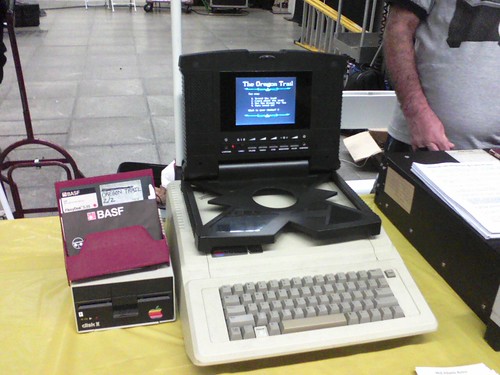
This year I attended my first HOPE conference. HOPE (Hackers On Planet Earth) is a hacker conference organized by 2600 The Hacker Quarterly. After hearing about the talks they had at 2008’s HOPE (The Last HOPE) when I was listening to the 2600 podcast, I knew I had to attend this year. I was not disappointed.
HOPE, if this one is an indication of how they usually are, is like an East Coast version of Defcon. Really, the only difference is that the atmosphere of the talks is slightly different given the HOPE being located in NYC vs Defcon being located in Las Vegas. While the playful hacker spirit is present at both, there’s usually an extra bit of an anything goes feeling in Vegas. There were also a few talks that were presenting preliminary versions of the data they hoped to present at Blackhat/Defcon. It makes sense, since those are the more prestigious hacker cons.
Apparently I mostly shoot wide
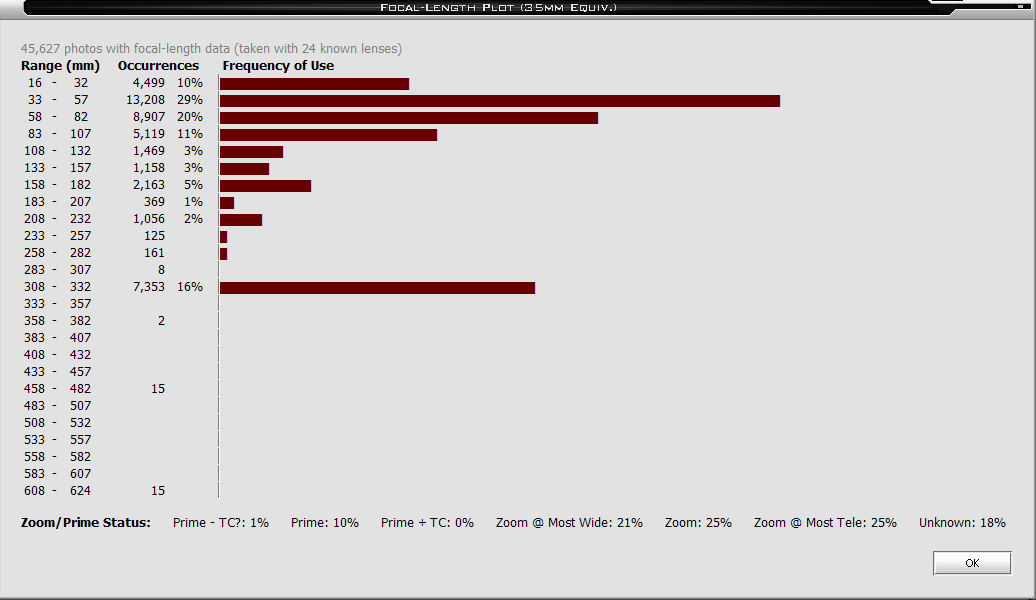
Heard about Jeffrey Friedl’s lens focal length plot plugin for Lightroom and decided to check it out. Here’s what it produced from my entire library.
Apparently I mostly shoot wide
Nearly 60% of my photos are in the wide to short telephoto range and nearly 40% is exclusively wide. Now, I do have SOME photos from others in my Lightroom catalog, but not enough to skew the results. I would say the reason for the huge concentration of photos in the 33-82mm range comes from the kit lens and its equivalent focal length USM version that I shoot a lot of photos with. The large concentration around the 308-330mm range comes from the 1.6x crop factor of my XT and XTi on the Tamron 55-200mm I use for wildlife photography.
More Trouble with Clouds

You Couldn’t Ask for Better Dramatic Clouds by DJOtaku, on Flickr
I previously blogged about cloud computing and, as you may remember, I am no fan. Recently, while listening to The Command Line Podcast, I came across yet another reason to stay away from the cloud. Cmdline mentions Bruce Schneier’s recent post on file deletion in the cloud. Bruce’s main point is that you can be reasonably sure on your own computer that a file is gone when you’ve deleted it. This is not the case with cloud computing.
Is it Obsolete? NPR Radio Stations
It Hasn’t Even Been a Year Yet… by DJOtaku, on Flickr
I am a huge listener of public radio programming, but I no longer listen to my local NPR station. Most of the time I just listen to podcasts of the shows that would otherwise be broadcast on NPR. The basic force behind this is the same as the reason why I loved my MythTV when I had cable TV. I don’t want to have to do appointment radio listening any more than I want to do appointment television. In many cases this is because the shows I enjoy listening to come on the air while I’m at work, in the gym, or sleeping. The shows I listen to are produced by NPR, Public Radio International (PRI), and American Public Media (APM). That includes Fresh Air, Talk of the Nation, On the Media, Media Matters, Wait Wait Don’t Tell Me, Away with Words and On the Money with Christ Disimio. Together with other non-radio programs and some BBC programs, these provide for all of my radio-listening needs. This started out (and a big reason I got into podcasts a few years after most techies had) because, in Baltimore, the local NPR station at 88.1 is interrupted by XM (or Sirius) FM transmitters. So I got pissed that whenever I happened to be available when a show I liked was on, every time someone with satelite radio passed by I couldn’t listen to my program. This is why I donated to the Washington DC NPR station - that one isn’t subject to interference so I’d rather pay for a station I can hear.