A Daily Photo: Busy Feeder

It was busy at the bird feeders with all the new birds. This little guy was unable to find a spot to land. I don’t know what he didn’t like about the bottom peg.
A Daily Photo: Digging Out

This is one of our neighbors clearing the snow out in his yard. Not sure what he was making a path to. Perhaps for his dog to be able to get to where he goes to relieve himself?
A Daily Photo: Weathering Out the Storm
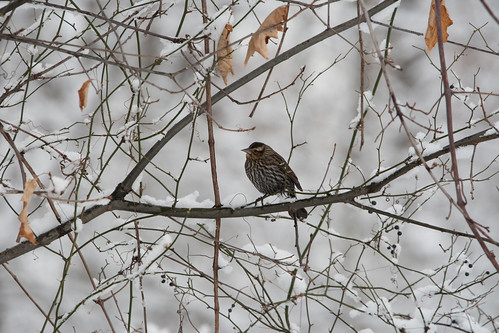
In case you’ve been under a rock lately, Maryland, DC, and Virginia got rocked by a huge El Niño system over the weekend. It dumped over three feet of snow in my neighborhood and nearly three feet everywhere else. The birds weathered it pretty well. Well, it helps that I felt bad for them and kept refilling the bird feeders. They were especially aggressive on the feeders this weekend for two reasons. 1) It was cold and they needed food to heat themselves by moving and 2) We had a bunch of new, large birds join the crowds in my backyard. The new birds included Red-Winged Blackbirds, Common Grackles, and European Starlings. Neither of these birds like Sunflower seeds, so they all kept going after the bird feed mix feeders. When I ran out of bird feed mix (a few days later) and was unable to buy any because of the snow conditions, I filled the feeders with sunflower seeds and they remained untouched for most of the day until the birds figured out that’s all they were going to get. Then they finished that off. I’ll be interested to see if they stick around after conditions improve.
A Daily Photo: Getting Dry

Sometimes the simplest things in life give the best pleasure. I love watching animals do the things they do. I pass by this lake chock-full of geese every day on my way to work. They’re only there in the morning before they go out in search of food and whatever it is geese do during the day. I wanted to catch them when the lake was frozen over to see how they dealt with it. Basically, they mostly treated it as though the shore extended out onto the lake. I shot at least a hundred frames and put up my best few onto flickr. This one became my favorite shot of the day.
Lighting Techniques 4: How I shot this

In this post I decided to take you through my thought process in lighting the photo. Because I wanted the knife as close to the camera as possible (while still being in focus), I had to lower the intensity of the flash on the camera. But that meant I would end up too dark, so I had use another flash to light me. I wanted to make sure that the flash lit only me and did not add any extra light to the knife, so I put a snoot on my flash. As we covered before, the snoot directs light forward with a very quick drop-off to darkness from the projected circle of light.
Lighting Techniques 3: How to get that shadow on the face

This one’s another subtle one because it’s so obvious, but if, like me a few months ago, you’ve only shot with available light, on camera flash, or bounced your light because you were told to - you probably haven’t thought about how light affects your portraits. And so you have always taken portraits where they came out good enough if the people were photogenic and not so good if they were average. Well, the key is creating realistic, but soft shadows. (Although, in fashion photography and other styles you may eliminate all shadows) The problem with on camera flash is that you end up with super harsh shadows. (Also, the behind-the-head ugly shadows that make the person look like they grew an afro) What you want to do is to soften up the shadows and move them to the side. Just remember this thing you learned as a child - shadows appear where light is blocked.
Lighting Techniques 2: How to get that flashlight look with your flash

You may have seen a photo like the one above where the light fades away as if it were a flashlight. How do photographers do that? It’s pretty easy, they snoot their flashes. A snoot is basically a light tunnel and professional snoots have a honeycomb grid at the end. The snoot directs the light and keeps it from spilling out to the sides so it all goes forward. The grid pattern at the end affects how wide the beam appears.
Lighting Techniques 1: Getting that White Background

Here’s a non-obvious problem that photographers come up against all the time - I bought a white background so why doesn’t it look white in my portraits? The reason that it’s a non-obvious problem is that you have to remember that the camera doesn’t see the world the same way you do. The internal circuitry of the camera wants to meter for neutral grey. So the cure is simple as long as you have an extra flash unit - you have to use it to light up the background. One important thing to remember if you’re using a small flash (speedlite or speedlight), you need to pop a diffuser cap on that lens to spread out the light over the whole background. In fact, if the background is wide enough you might need two or more strobes. Another tip is that it may help to put your flash unit into manual mode so the flash itself doesn’t try to make the background neutral grey.
February Background Calendar
Here’s the calendar for February. Click on it to get the full size so you can make it your background. ( edit: I noticed a bug in the way the calendar appeared and fixed it on 31 Jan 2010 so just download a new version, thanks!)
For square screens:

Feb 2010 - 1024x768 calendar (fixed)
For wide screens:

Feb 2010 - 1680x1050 calendar (fixed)
A Daily Photo: Northern Mockingbird

This Northern Mockingbird is one of the many birds in my yard. I can’t quite pinpoint what it is about birds that fascinate Danielle and I, but we love to watch them cavorting around the yard and interacting with each other.