gNewSense 2.0 (deltah) Review
So gNewSense 2.0 came out a few days ago as the gNewSense crew is tracking Ubuntu LTS releases. Of course, the bad part is that there is no upgrade path from gNewSense 1.0 to 2.0. Ubuntu recommends upgrading by going from release to release so upgrading is not feasible (or is too hard for the developers to implement) so freedom lovers need to have a good backup strategy.
Since I reviewed gNewSense 1.0, I wanted to structure this review as comparing and contrasting this release to the last one to see where the progress has come. They have a much cooler looking desktop background. There wasn’t anything wrong with the last one - it just didn’t have as much of a cool factor. They still have ugly icons on the screen.
Raptor Menu explores KDE 4 Possibilities
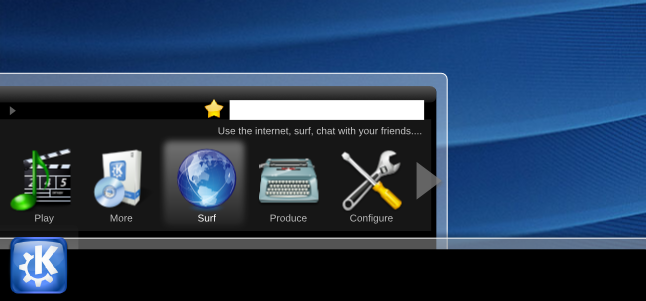
Some developers are working on a neat new program menu for KDE called Raptor Menu. Thanks to Plasma and other underlying KDE 4 technologies it is now a pretty trivial hack to change the program menu if you don’t like the default. Such enhancements exist for KDE 3, but they are all very kludgey. Thanks to Plasma’s modular nature, it’s easy to replace it. Even the KDE developers have acknowledged this when people have complained about their new program menu. Bear with them to fix it, they say, but if you don’t like it, it’s now very easy to implement your own.
Upgrading to Mythdora 5.0
Written Friday, 2 May 2008
Today I decided to upgrade my Mythdora to the latest verison, 5.0. I downloaded the CD media and booted into the install. I had to do a text install to be able to watch it on my TV. Then I just needed to yum install the kmod-nvidia drivers. (Although, first I had to uninstall the previous nvidia drivers - they were neither automatically upgraded nor uninstalled) I started at about 1930 and was able to be completely up and running by 2055, just in time so that I didn’t have to missmy 2100 recording of “Best Week Ever”.
Getting Totem's MythTV plugin to work
One of the new features of Gnome 2.22 is the fact that Totem now has a plugin to access your MythTV programs. I installed the plugin and found myself wondering what to do next. I checked on Google for totem mythtv and didn’t find anything until today when Google finally got around to indexing a forum post about it on the Ubuntu Forums. I followed the directions about editing Gconf and had success!
Absolute First Impression of Ubuntu 8.04
Last weekend, it had been a few days since the latest Ubuntu hit the net and I hadn’t heard of any major upgrade SNAFUs so I decided to upgrade. I wanted to record my absolute first impressions without doing much, just to see how I felt. The upgrade went by without anything bad happening. My wireless connection still works and nothing major seems to have gone wrong. I went through each of the things I’d heard hyped about in Ubuntu and checked to see how they had changed.
Having all distros release at once?
The Open Source Advocate has an article discussing the merits of all the distros releasing on the same schedule. His main argument, bolstered by quotes from Shuttleworth is that by having them all release at the same time, they will end up with the same software and cause a massive synchronization across all major open source projects. The 2 main quotes I’d like to focus on are:
“Simply set a hard date and modify your goals to make that release date.” - Article Author
One last, good look at KDE 3 Part 2
Some little updates on my KDE experiment. First of all, I run an rsync script semi-daily to backup my home drive to an external hard drive in case the main one fails. It’s already happened to me once before and I was really glad to have had backups. However, as you can imagine, this is a huge drain on my computer’s resources while the backup is being performed. Since I have it running from a cron job so that I can just forget about it, I tend to forget when it’s set to run and I get really annoyed if my computer starts slowing down and I can’t figure out why. So I put a wall command into my script. This sends a message to all terminal emulators and everyone logged into the computer via terminals or ssh. Usually in Gnome I can only see the message if I happen to have Gnome termnal open. However, KDE does something very awesome and useful. Here’s a screenshot:
Ubuntu 8.04 Released Today!
Ubuntu 8.04, Hardy Heron will be released today. As the name implies, 8.04 will be Hardy because it is a Long Term Support (LTS) version. This means that for 18 months they will release security updates. What does that really mean? It means that if you like Ubuntu, but don’t feel like upgrading every six months, you can stick with Hardy Heron for 3 release cycles. You won’t get the latest programs, but you’ll get security updates to protect you against crackers, viruses, and other malicious things.
Fedora Pre-Upgrade: Finally!
As many of you know, according to the Google search terms that bring people here. I am of the not-so-humble opinion that Fedora’s upgrade process is about as pleasant as being forced to walk through the desert without a canteen of water. First of all, they recommend to just do a fresh install which is a non-starter for me. I’d have to waste way too much time restoring all my files and settings. Ubuntu and Debian seem to get me through upgrades without reinstalling without any problems. I blogged about the horrors up upgrading to Fedora 8 here and here. I blogged about how awesome the yum upgrade worked here, here, here, and here.
Finally...evaluating the purpose of both Gobuntu and gNewSense
I’ve always been the first to jump to the defenses of people who love creating more distros and programs. After all, if everyone just stuck to the established distros we would never have had Ubuntu and perhaps Linux would still be just a curiousity to most. However, I just didn’t see the purpose in both Gobuntu and gNewSense. First of all, they’re both based on Ubuntu. It’s not even that one is Ubuntu and one is Debian or that one is Ubuntu and one is Red Hat-based. That would have made sense to me as perhaps they liked a different packaging format or something.