Review: PCLinuxOS 2009
note: I started writing this months ago when I did the installation and now I am finishing up by looking at the installed distro. PCLinuxOS started as an extra set of packages for Mandriva. Interesting because Mandriva originally started as a KDE version of Red Hat. Eventually, it became its own distro. It became very, very popular around the same time as Ubuntu - give or take a few months. There was a time where you couldn’t read a Linux review without someone in the comments suggesting you should check out PC Linux OS. (Kinda like what I see happening with ArchLinux nowadays) The distro built up lots of steam and in 2007 seemed as though it could potentially steal Ubuntu’s thunder. Then it suddenly dissapeared from mention. There wasn’t a full-fledged 2008 release. According to its wikipedia page, PCLinuxOS has twice forked from Mandriva. So, while it was based on Mandriva at that point in time, it has since diverged into its own distinct distro. This is a very interesting distinction because this month I am also reviewing Mandriva 2009.1 and I had to postpone that review because it wouldn’t load up. PCLinuxOS, on the other hand, did load up. First up I had to choose my keyboard type.
Review: Zenwalk 6.0
Back in Nov of 2008 I checked out Zenwalk 5.2 and a recent LXF contained Zenwalk 6.0 - so let’s see what has changed. It loads up with the usual Kernel messages going past on the screen. The first screen for the installation hasn’t changed one bit from Zenwalk 5.2.
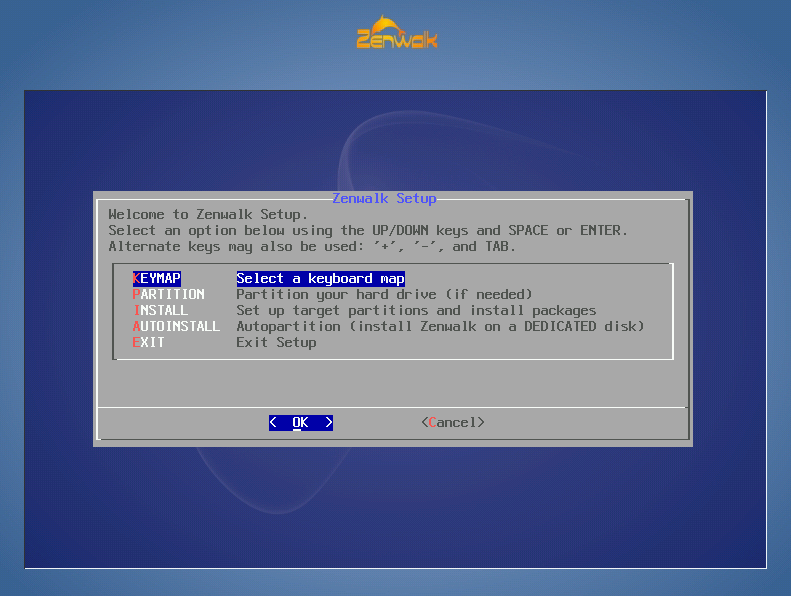
Zenwalk 6.0 - setup ncurses screen
Once again, as before, I chose autoinstall. Once again, the installation was sparse, but very, very informative. I don’t think I mentioned this last time, but it appears that Zenwalk 6.0 (maybe earlier versions as awell) uses the xfs file system instead of the more usual ext3. (Or, recently, ext4) According to the wikipedia article I linked to, XFS is very good for large files and is one of the oldest file systems for *nix systems. Just like last time, the installation had information on every single package as it was installed. Just as last time I want to say that this installation was very, very simple. I don’t see why anyone new to Linux (but not a total computer noob) would have any problems installing it. Sure, it’s very short on eye candy - but who cares? You should only ever see the installation screen once. Just as before, I am convinced that Zenwalk is a very good introduction to a Slackware-type distribution thanks to this ease of installation.
Fedora 11 Released!
I missed the release by a couple of days, but as is my tradition, here is the release notice:
Ladies and gentlemen of the Royal Explorers Club! Your attention please. It falls to me to be the host of our proceedings to-day, as we celebrate a great achievement in the annals of this hallowed organization – the discovery of what is truly a magnificent specimen among all FOSSdom. When Dr. Brattlesworth and I began this safari more than six months ago, we knew full well the many snares, toils, and dangers that awaited us along the hundreds of miles of tracking our quarry across the plains. But we also maintained a steadfast belief that by living with the land, and becoming part of the larger ecosystem where this incredible animal takes refuge, we could record for posterity the way of life of that marvelous creature – the Leonidas!
Review: Ubuntu 9.04
This is going to be the first time I look at a fresh install of Ubuntu in a long while. I first installed Ubuntu quite a while ago and then I just kept distro upgrading from there on. Then I installed Crunch Bang Linux on my laptop. So now I will be testing the installation. This may end up being a pretty short review because not much has changed from the previous Ubuntu, or so I hear. The biggest new change is the notification system. I’ll be sure to check that out.
Review: SimplyMepis 8.0
SimplyMepis is a Debian-based distro developed by Warren Woodford who believed that Mandrake Linux was too hard for new users. (Mandrake, now Mandriva, was the Ubuntu of its time). I’ve heard him interviewed a few times on The Linux Link Tech Show and he seems to be of the realist (as opposed to idealist) school of Linux distro maintainers. He believes users should be able to listen to MP3s, use Adobe Flash, and so on. SimplyMepis 8.0 is based on Debian 5 stable, which I recently reviewed. So let’s load her up into VirtualBox and see how it goes.
Migrating Tomboy to 64bit and Debian 5 Wifi Installation FAIL
I recently finally moved over to my 64bit computer. I’ve been using Fedora 10 64-bit for at least two weeks now. I was having a lot of trouble with migrating my Tomboy data over from the 32-bit install. It wouldn’t start up and the error message was not as helpful as it could have been. Eventually I dug around and found out I had to delete all the addin* files/folders in my .tomboy folder. After that everything worked fine.
Linux Reviews Coming....
This month’s LXF came with SimplyMepis 8, Zenwalk 6, and PCLinuxOS 2009. As soon as I get moved and the world stops turning upside down I’ll get those posted.
Super Mini Review: Fedora 10 64-bit
My wife said since she isn’t using the Linux computer I built for her, that I could use it. It has a Intel Core 2 Duo Dual Core chip, so I was pretty excited to try out 64-bit computing to see if there would be any problems. I installed Fedora 10 since I’m used to that platform. Installation process was pretty much the same as with 32-bit. It took 20 minutes to install. Blender was found in the repositories along with Inkscape - so far so good!
Review: Debian 5: Lenny
Debian…the father and grandfather of many a Linux distro. I think indirectly Debian is probably running on more computers than any other Linux distro. It’s the basis of Ubuntu, Mepis, Xandros, and many others. And many people use Debian where they need a nice, stable distro. The fact that Debian’s stable releases come out every one to two years and remain supported for a year after a new stable version means that it’s the darling distro where stability is needed. As great as Ubuntu is, you just can’t keep updating every 6 months on a production machine. Now, the flipside is that Debian tends to have older software all-around. So it tends to be used more as a server distro than a desktop distro. But more people than you would expect do run it on their desktops. Afterall, what does the latest version of Gnome have that you REALLY, REALLY need?
Review: Nova Linux 1.1.2
I recently heard that Cuba had created their own Linux distribution, Nova. Like many other countries with a rocky relationship with the USA (Russia, China, Iran), Cuba is wary of running their entire computer infrastructure on software developed in the USA. As someone of Cuban ancestry, this development piqued my interested and I decided to check it out. (I figured such a specialist distro would never be on the cover of LXF). According to its distrowatch page, it is a mix of Gentoo, Sabayon, and Ututo. We’ll see if they chose all of the negative aspects of those distros and thus created Satan’s Distro or if they took all that was good and created what Gentoo has the potential to be. So I launch it up in VirtualBox.