Review: Alternity

My rating: 3 of 5 stars
There are a few things in this book that are a bit on the nose - for example, there’s a distinct Moon theme going on with a bunch of things and the main characters are Skye and Dawn. However, the deeper you get into the book, the more these things make sense. There are similar themes are Alice in Wonderland and The Wizard of Oz that are referenced via the names of things. At first I found it slightly annoying, but eventually it just seemed like a crazy meta commentary on how there are no truly original stories and everything is borrowing from the stories that came before it. So what starts off clunky ends up being much more seamless at the end.
Review: This is How You Die: Stories of the Inscrutable, Infallible, Inescapable Machine of Death
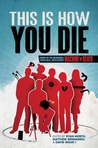 This is How You Die: Stories of the Inscrutable, Infallible, Inescapable Machine of Death by Ryan North
My rating: 4 of 5 stars
This book was more than just more stories in the Machine of Death world. It was also the Machine of Death in fantasy worlds and science fiction worlds and all kinds of creative new worlds. It was a lot of fun and a great followup to the first book.
Review: The Rapture of the Nerds: A tale of the singularity, posthumanity, and awkward social
 The Rapture of the Nerds: A tale of the singularity, posthumanity, and awkward social situations by Cory Doctorow
My rating: 3 of 5 stars
Once, a long time ago, I starting reading The Illuminatus Trilogy. I’m not sure why, but I think someone who was also into scifi had recommended it to me. Between its strange pacing and storytelling and sexual content I wasn’t quite ready for, I didn’t get it and quit early.
Review: The Sagan Diary
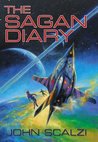 The Sagan Diary by John Scalzi
My rating: 4 of 5 stars
This is best read right after the original trilogy so you can get all the references. As these are Jane Sagan’s BrainPal diary entrees, Scalzi doesn’t over describe the references.
It’s much more poetically written than other Scalzi stuff I’ve read, so it was neat to see him showcase some of his other writing talents.
Review: Questions for a Soldier
 Questions for a Soldier by John Scalzi
My rating: 3 of 5 stars
Full of inside jokes for readers of the first trilogy and a chance for Scalzi to expand on Perry’s thoughts which would have been too awkward to fit in during the original narrative.
Review: Tiger Eye

My rating: 4 of 5 stars
I set out to see if I could enjoy a romance book. I got this Marjorie Liu book for free from Barnes and Noble in a Friday giveaway. The cover promised a cheesy romance, but I knew going in it was Liu who I loved on X-Men and I knew it was a paranormal romance, to which my wife said “like the movie Ghost?”
Book Report 2015 Q2
A mixture of a growing Ebook library, tracking my goals in Goodreads, and Calibre’s ability to generate a catalog have made me decide to start tracking things quarterly in the book dimension as well. Here’s my second report.
Total Ebooks: 417 (increase of 54 books)
Total Unread: 313 (increase of 45 so I’m reading them faster than I can add them…good)
Goodreads 2015 Challenge: 38 of 30 books complete. Last time I went way over. We’ll see what this year brings.
Review: Machine of Death: A Collection of Stories About People Who Know How They Will Die
 Machine of Death: A Collection of Stories About People Who Know How They Will Die by Ryan North
My rating: 4 of 5 stars
This book is, in a way, not what you think it’s going to be when you read the premise. Essentially it’s a dozen or so Oedipus Rex stories - in the oracle sense, not the incest sense. There is a machine called The Machine of Death and it tells you how you will die. Not when (except in one story). Just how. So if you get CANCER you might die of cancer in two months or at age 99. Sometimes, like Oedipus, what you do to avoid it causes it to happen. Other times that’s not the point of the story, but it can’t be avoided. If your death is EATING A PEANUT you cannot commit suicide by any way other than eating one. The predictions are also vague and/or ironic. OLD AGE might mean you die old or it might mean a senior citizen kills you. So I thought this would be a bunch of stories of people trying to outwit the machine. Instead, what I got were about a dozen stories in which the authors explore how our world would change with the existence of the Machine of Death.
Review: Just the Tips
 Just the Tips by Matt Fraction
My rating: 5 of 5 stars
This book is like the 90s movie Booty Call. It’s funny in a really dumb, immature way. What’s sad is that the tips in all those women’s magazines should be treated with about as much seriousness as these tips, but some people actually take them seriously. It also includes some hilarious joke sex positions and reader-submitted stories.
Review: Old Man's War Boxed Set 1
 Old Man’s War Boxed Set 1 by John Scalzi
My rating: 5 of 5 stars
I have rapidly become a Scalzi fanboy. I’m proof of the sentiment behind Scalzi’s new $3 million deal - when someone reads one Scalzi book, they read them all. I don’t believe it discounts what I’m going to say, but it’s worth noting up front. Starting with The God Engines and going through Red Shirts, I’ve built up a huge enjoyment for Scalzi’s style. What style is that? I’ve had a hard time articulating it to friends and family. Here’s my best shot - Old Man’s War is not a comedy, but it’s funny. It’s an like action movie, but it’s not dumb. The humor mostly comes from witty or sarcastic responses by the main characters. Even though it’s framed as a military action book, it’s mostly a series of character studies. I also enjoy that both within a book and within the series, Scalzi only doles out information as needed. This has two good effects. First, there are no info dumps - or if there’s more than one paragraph of explanation, it’s the only way Scalzi has of conveying it Second, as we learn more of the universe - either through our POV characters learning more or by going from regular army to special forces, it forces us to re-evaluate what we learned before in a new light. Most apt in that comparison is the scientist telling our main character early in the first book about how the space elevator is designed in such a way as to be a symbol of how much more advanced the Colonial Union is than Earth without revealing just how advanced. With all that’s learned (mostly in the second two books), the scale of that deception is truly realized.