AI Updates 20260906
EricMesa
- 7 minutes read - 1305 wordsAfter a period of exploration that peaked while I was vacation with a lot of time on my hands, my usage of AI has more or less fallen back to where it was before my blitz of AI posts a couple weeks ago. This post is a summary of some interesting AI-related topics since my last post.
AI And Learning
In my 23 Aug post about Positive AI usage I mused on some ways that students might be able to use AI in a positive way instead of just having it be a complete negative. Since then I heard a Fresh Air episode about how tech giants influence American schools that mentioned Estonia making a deal with one of the AI companies to make it only answer socratically if a student was using it. Combining that with what I wrote in my blog post it was interesting to get this email from ChatGPT:
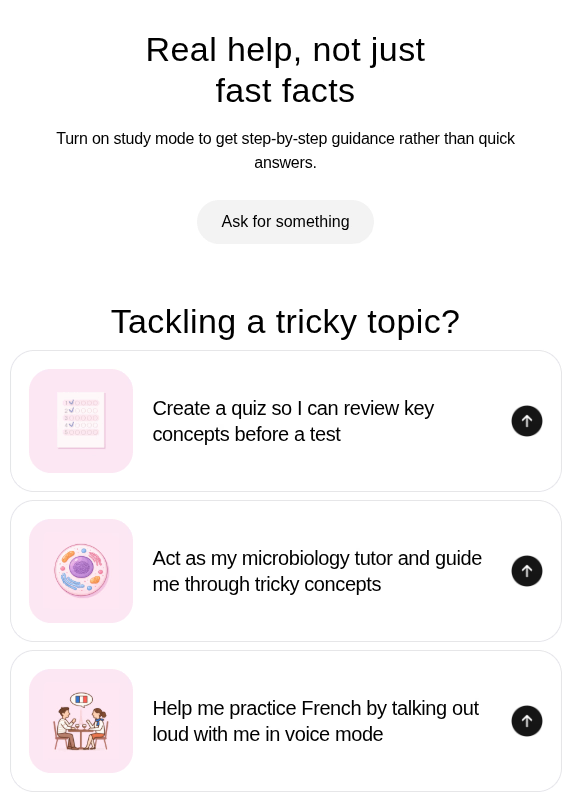
Study suggestions from ChatGPT
You can see the “study mode” which seems similar to the Estonian idea and the quiz idea I came up with in my blog post.
Running things locally
A lot of my previous posts were mostly about running AI locally on my own systems, so let’s start with that situation first. I learned about, and set up, openWeb UI to provide a web interface to my Ollama container. It seems to be based on a mix of ChatGPT and Claude’s web interfaces. It can also do the model comparison that I wrote a script to do. I learned how to allow it to search the web as part of its answers. I also learned how to use MCP servers by testing the Talk Python MCP server.
After I got back home from vacation I set up the Ollama containers on the used rack-mount server I bought (with about 128 GB RAM) and on my newly upgrade NAS server (also about 128 GB RAM). My NAS runs the local AIs (Gemma 4 e4b and Phi4-Mini) at nearly the same speed as the Cloud-AIs (like Claude and Gemini). I did some Googling (and chatting with Gemini) and learned 3 things:
I learned the contexts to set up for each of the servers and my main computer to have the best performance possible considering the fact that I don’t have any graphics cards that are new enough/performant enough and have to run on the CPU The reason the NAS runs near-cloud speed compared to the older server (with the same RAM) is that the old server and my main computer don’t have the latest vector instructions, while the newly upgraded NAS does. No local install would work well in Agentic programming mode. It would need more context than I could give on any of my servers (without risking messing with the other services on those servers)
Even with a decently fast AI response on my NAS, I still prefer the answers I get from Claude or Gemini. (And Claude more than Gemini) This might be because I have a knee-capped model, because I have to limit web searches (to not use up my API limits), or some other reason. However, it is nice to have a local, responsive AI that I could use if I need privacy with my prompt or if I run out of free tokens on the cloud AIs.
One more thing - I just want to point out a comparison of Qwen 3.5’s description of a photo to Gemma’s. Gemma is not wrong, but it’s certainly not as right as Qwen
This is a black and white photograph featuring a group of approximately eight young women posing outdoors. They are standing on a wide set of concrete or stone stairs in front of a large, institutional-looking building.
The women are arranged in several rows, with some seated on the lower steps and others standing on the higher steps. They are dressed in casual attire typical of an earlier era. The overall mood of the photo is nostalgic and friendly, suggesting it was taken during a gathering of friends or classmates. The architecture behind them, with its multiple windows and columns, gives the background a formal, educational, or residential feel.
I asked: what region of the world is the clothing from?
Based solely on the photograph, it is very difficult to pinpoint a specific region of the world for the clothing, as the style appears to be Westernized and was common in many parts of Asia and elsewhere during the mid-20th century (likely 1940s to 1960s).
The silhouettes—simple, modest dresses and blouses—are typical of general global fashion trends from that era. Without more distinct cultural patterns, unique textiles, or specific identifiable garments, I can only say the style aligns with common post-war global fashion trends rather than a single, specific region.
Definitely not as good as Qwen 3.5.
Useful AI Tasking
For a few years now I have been using Kdenlive’s install of Whisper to do automated subtitling of my YouTube videos. (not the Let’s Plays, but the video essays) It seems to work WAY better than YouTube’s generated subtitles. I usually only need to do a couple tweaks if I mumble my words or with some TTRPG terms (although it gets LOTS of them surprisingly right!)
Well, one of my Starfinder players who was having trouble remembering things between sessions wanted to know if we could summarize our sessions so he could read that. (There are reasons I don’t want to get into why he couldn’t just take notes) So I worked first with Gemini and then with Claude (when Gemini kept giving me non-working python scripts) to set up a whisper pipeline to do a “diarize” which means speaker detection. (Note: I had to clean up the script a bit on my own - so thankfully I know Python and wasn’t just vibe-coding) While it takes hours to run 1 hour of audio on my computer, it runs pretty fast on my NAS server.
I do NOT use those summaries for my Starfinder posts. (The first one that was even ready to post after I wrote this script was session 04). But I did use it to get caught up on my Tales of the Valiant posts. (Which I am now back to writing on my own)
Are AI Results just Hot Garbage?
If your instinctive answer is “yet”, MOST LIKELY your experience with AI with chat bots - Claude or Gemini when searching on Google. While those have gotten WAY better in the last few months, they are still prone to making stuff up or pulling from bad sources like reddit memes. It has mirrored my journey with smartphones. The first time I saw my brother use a smartphone, I thought it was pretty dumb and a waste of money. Google maps took us in circles in Chicago. Now I find them to be immensely useful for both work and play. The same has happened with these chatbots. But they are still pretty bad.
However, if you’re a programmer you are most likely having a MUCH NICER experience if you’re using Agentic AI instead of chat LLMs. While they aren’t perfect, when the Agentic-style AI can see your entire repo and produce code or fix bugs based off of that, it tends to be INCREDIBLY better. This isn’t just me saying this - the programmers at Talk Python and a Fallthrough have said the same thing. However, they aren’t perfect. Recently, Mike Kennedy of Talk Python pointed out that we don’t expect human programmers to be perfect, so it’s odd to expect AI, which is more human in its output (instead of deterministic) to be perfect. You should essentially treat any code you get from an agentic AI the same as you would code from another human who is supposed to be good at coding.