Murder in Metal City: Session 01
EricMesa
- 9 minutes read - 1785 wordsFor the last 6 or so months I’ve been saying all over the internet (this blog, enworld, Blue Sky) that the Cosmere TTRPG’s use of the 3 action economy had piqued my curiosity in Paizo’s 2e *finder systems. This last Friday, I FINALLY got to run the Starfinder adventure that I’ve been dying to run for my Cosmere group for the past few months - Murder in Metal City. (Buy it directly from Paizo if you are part of Paizo Plus and want the points OR want to bundle it with the PDF or Buy it directly from FoundryVTT’s marketplace). I have to say that I was not disappointed.
The Foundry Conversion
Most, if not all, of Paizo’s FoundryVTT conversion are handled by Metamorphic Digital. They go above and beyond any FoundryVTT conversion I’ve seen for D&D, Tales of the Valiant, or Cosmere. Not only do they do the bare minimum of scenes pre-configured with walls, lighting, and baddies and hazards - they also do a TON more that makes this a really great way to run the game virtually. They provide artwork and tokens for all the monsters and NPCs in the adventure. They have custom digital dice - one of the things that made my jaw drop was when I rolled damage for the smog scamps and the die looked all dirty. (This is what Dndbeyond SHOULD be doing with their special dice!) They have journal entries embedded in the maps to bring up the exact page you need to run them. All kinds of macros are set up to do things that change up the map. They have background sounds by Michael Ghelfi Studios. It is fun how much my players enjoyed the immersion that comes from adding the right sound loop into the background. If you spend enough time online you will know that Metamorphic is top notch and their Paizo modules are WELL worth the price.
Starfinder on FoundryVTT in general
I’ve written about this a lot (as well as mention it in videos), but one of the best things about the Paizo RPGs is that they are the pioneers of having all the rules available for free. (Copied by Draw Steel and, I think, Nimble v2) This means that a GM can run Starfinder or Pathfinder (first or second edition) without paying a dime to anyone. This goes quite well with Bob the World Builder’s recent video about the cost of TTRPGs - mostly focued on D&D - in which the main thesis of the video is that it does NOT have to be expensive to play TTRPGs.
That aside, there’s a lot of great stuff that’s automated on the system as you can see in this video I made to help my Cosmere RPG table convert over to Starfinder 2e:
Also, after I made that video I discovered 2 other neat features of the system:
The system comes with a built-in party view:
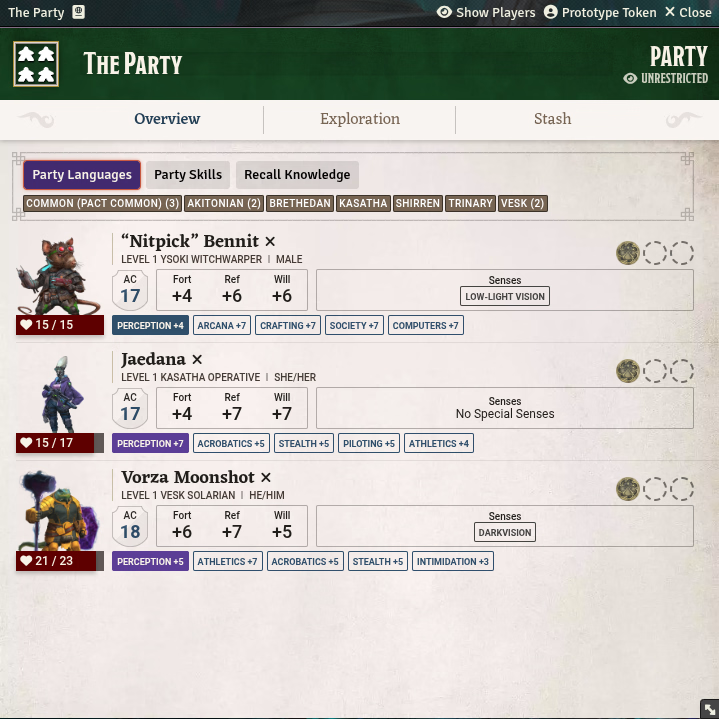
Party view
This is similar to one of the pages I have on my custom GM screen when I’m playing in person. I have a page with all the player stats so that I don’t have to keep asking my players if something hits, what their max HP is, passive perception, and so on. But the Paizo FoundryVTT systems give this to me for free! It also tells me what languages they speak, their skills and so forth. It also has a tab for “the stash” which can be used to keep items the players don’t need on their person at the moment:
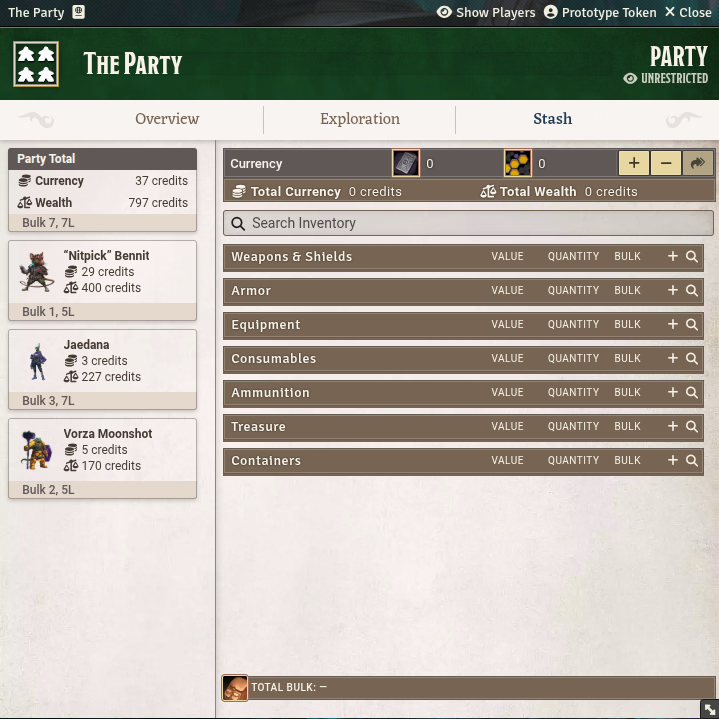
Party view: The Stash
Additionally, something that usually needs a plugin in 5e systems for Foundry is the “loot” item:
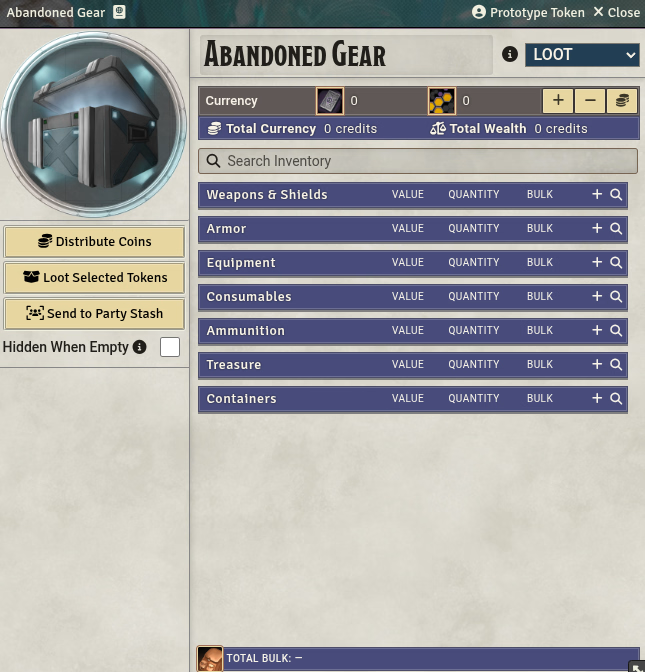
Empty loot
In this screenshot it seems less useful because my party has already looted this loot. In the case of Murder in Metal City - Metamorphic has these pre-setup so that I don’t have to go digging through the compendiums to find the loot to hand out to my players. I wish more systems and modules did this!
Our Game
Player Characters
The Paizo TTRPGs are known to be a bit overwhelming when it comes to character creation. They tend to have tons of ancestries (species or races in other systems) and each of those has variants. Then there are feats (both ancestry and class) that are found across many different books. Speaking of classes there are classes, subclasses, and archetypes. Additionally, this was our first time playing Starfinder 2e, so it would have been too easy to end up with an accidentally broken build. So for this first outing in the system we went with the pregens. As a Deluxe Adventure (equivalent to the Game Night: Dawn of the Frogs for Pathfinder (and currently on sale at Humble Bundle ) it come with pregens that should already be balanced for the game.
My brother David chose Vorza Moonshot, a Solarian Vesk, that he is roleplaying as Wrex from Mass Effect.
Chris chose Nitpick, a witchwarper Ysoki, and is having fun with the roleplay aspects - kinda leaning into making the character a bit of a cad.
Drew chose Jadeana, an Operative Kasatha. Drew has augmented the backstory in all kinds of fun ways that I hope to be able to surface throughout the adventure. He always goes all out with character backstory. (each player brings me a different joy to running the game and this attention to character detail is hiss contribution) If the table ends up enjoying Starfinder, I can’t wait to see what kind of character he creates when he can create one from scratch.
My Intro
Since the table is brand new to Starfinder 2e while I’ve been marinating in the Galaxy Guide, Player Core, and GM Core since Christmas of last year (plus the awesome fiction), I wrote this intro to set things up before jumping into the adventure’s pre-written narrative cues:
“As we begin our adventure, all three of you find yourselves on Aballon, the anacite planet for different reasons. Anacites are thinking machines created by the First Ones, a long lost culture that once resided in this solar system - the Pact Worlds system. Anacites often, though not always, resemble arthropods as they find this to be the most efficient body plan. Each individual anacite will further modify their body as they see fit. There is no official economy on Aballon as the Anacites simply assign tasks, housing, and goods as needed to keep society functioning. Therefore each of you has a place you can call your own within the city of Striving, also known as Metal City. Although you’ve never met each other before, there is one thing that ties you together - a relationship with Tier-99-Professor, known to you by his nickname Tierny. As you go about your day, you receive the following message on your comm unit: (give players handout #1)”
After any RP and/or questions…
“What were you doing when you got the message and add a consequence of the message what do you do differently over the next 2 days? (after their answers) In what order will you guys arrive at Analog?”
From there we were off to the races and doing all kinds of fun roleplay. At some point someone noted they were doing more roleplay than when we played Cosmere.
How did things go?
We stopped as the party was arriving at the Charging Station. (We have a very strict stop time for our table - it works for us - your mileage may vary) The players were very good at roleplaying the meeting at the Analog Cafe and asked good questions of Ghellon. They failed to catch up to the drone, but they did excellently with the smog scamps! Pathfinder is much more rewarding of teamwork than D&D. Because crits can happen at 10 over and 10 under the DC (not just 1 and 20) a lot of the strategy revolves around using your players to modify the enemy’s AC or the player’s ability to hit. This is done by characters like the Operative or Envoy who can buff and debuff while the soldiers and solarians can jump in to smash stuff up. Drew used Jadaena’s ability to give the enemy Clumsy 1 to make it incredibly easy for Dave to come in with Vorza and do mostly one-shot kills. He also played the roll of tank extremely well as he had the most HP by far. Chris made good use of his cantrips both in exploration mode and in combat. My favorite move of his during the battle was to get into an abandoned car and force the scamps to waste an action trying to break the windows before they could attack him.
I’m not sure what’s different in Starfinder vs Cosmere. I don’t know if it’s because we’re not playing in Sanderson’s sandbox or if it’s a science fantasy setting vs a more fantasy setting, but the table did a better job with roleplay, with asking questions of the NPCs, and with battle tactics than they did at this point in their familiarity with Cosmere. It could also be that the players have had 6ish months to gel and learn how the others at the table play TTRPGs so they can play to their fellow players’ strengths and make up for their weaknesses. Whatever the reason, it’s making it even more fun for me to GM this adventure.
How is the mystery solving is going?
So far so good! I haven’t had to fudge any hints yet for the players. They’ve been able to take what’s going on and piece together where to go next and who might be involved. Next session will be the true test since it’ll be 2 weeks since we played, but hopefully somewhere between 1 and 3 of them have taken good notes they can use to maintain continuity.
Conclusion after Session 1
I am having a great time running this adventure. The FoundryVTT conversion makes it easy and pleasurable to run and my players seem to be enjoying the setting and the characters. I’ve been spending some portion of my free time since Friday going over the next few challenges the players will face. We essentially stopped just before the end of chapter 1. For reasons that I don’t want to give away to the table, I will need to have most or all of chapter 2 in my head if we get that far next session.
We’ll see how things go, but my plan is to make a blog post after each session (probably shorter than this one since it won’t need all the preamble) and then I’ll probably do one big wrap-up post at the end.